
Overview
Magnet Methods has extensive expertise in the design and development of magnetic couplings, including both rotary and linear configurations. This case study explores a recent project involving a permanent magnet synchronous coupling designed to operate under high-speed conditions and across a pressure-separating wall.
Project Scope
- Type of Coupling: Permanent Magnet Synchronous
- Field Configuration: Axial and Radial
- Application Requirements:
- Low speed, high torque operation
- Fluid isolation
- Moderate pressure differential
- Synchronous torque transfer
Design Highlights
Axial vs. Radial Field Magnetic Couplings
The project involved evaluating both axial field and radial field magnetic coupling configurations. Each has distinct advantages depending on the application:
- Axial Field Coupling:
- Suitable for low-speed, high torque applications
- Flat dividing wall – less good for supporting high pressure differential
- Has optimum number of pole pairs depending on geometry
- Radial Field Coupling:
- Better suited for high speed applications
- Cylindrical dividing wall more effective for high pressure differential
- Has optimum number of pole pairs depending on geometry
Finite Element Modelling
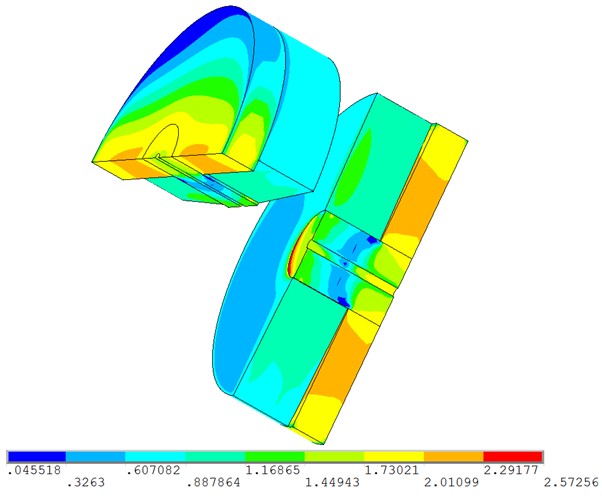
A fully parametric FEA model was used to asses torque capacity and other aspects of performance. For computational efficiency, only a single pole was included in the model, using appropriate boundary conditions to leverage rotational symmetry.
Engineering Considerations
Material Selection
- Dividing Wall: Non-ferromagnetic alloy used for fluid isolation
- Magnet Configuration: Designed for best compromise – back iron flux density vs leakage
- Eddy Currents: Not modelled in this low speed application – critical at higher speeds
Torque Transfer
- Synchronous Only Operation: Torque transfer only at zero slip speed.
- Transient Loads: Can cause desynchronisation, leading to potential heating and magnet demagnetisation
- Pole Count: Designed to minimise coupling envelope while meeting torque requirements.
Performance Outcomes
- Reliable Torque Transfer under synchronous conditions
- Effective Fluid Isolation using axial field configuration
- Scalable Design adaptable to various pole pair configurations and pressure requirements
Conclusion
This project demonstrates Magnet Method’s capability in designing custom magnetic couplings tailored to demanding engineering environments. By considering materials, geometry and pole count, we were able to deliver a solution that met all of the performance and environmental requirements.