
Case Study: Finite Element Modelling for Fault Current Limiter Development
Overview
Magnet Methods supported a Cardiff University start-up in the development of a novel permanent magnet-based fault current limiter for electricity grid applications. This project leveraged advanced finite element modelling (FEM) techniques to optimise the design and simulate performance under various fault conditions.
Project Scope
- Client: Cardiff University start-up
- Application: Electricity grid fault current limiter
- Technology Used: Permanent magnets with heavily saturated soft iron, circuit simulation
- Goals:
- Rapid design iteration
- Performance optimisation
- In-circuit fault simulation

Design Highlights
2D Finite Element Modelling for Rapid Prototyping
Initial modelling was conducted in 2D, allowing for:
- Fast run times
- Interactive design exploration
- Generation of trend curves
- Early identification of key design parameters
Although less accurate than 3D modelling, this phase was critical for rapid understanding and iteration.
3D Modelling for Detailed Refinement
Once the design was matured, 3D FEM was used for high-fidelity analysis. Key features included:
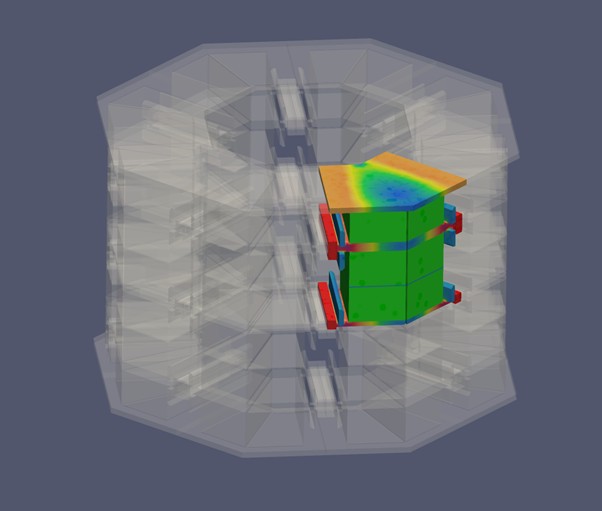
- Use of combined periodic and plane symmetry boundary conditions
- Modelling only 1/16th of the full geometry for computational efficiency
- Detailed analysis of magnetic flux density (B) in iron components
Performance Simulation
Beyond static field modelling, the team used derived performance parameters in circuit simulations to evaluate the limiter’s behaviour under various grid fault conditions.
These simulations helped validate the design and ensure robust performance in real-world scenarios.
Engineering Considerations
- Magnetic Material Behaviour: Accurate modelling of iron parts at high field conditions
- Computational Efficiency: Strategic use of symmetry to reduce model size
- System Integration: Simulation of circuit behaviour under various grid fault events.
Conclusion
This project showcases Magnet Method’s ability to combine rapid prototyping with high-fidelity modelling to support innovative grid technologies. The fault current limiter design benefited from a structured modelling approach that balanced speed, accuracy, and system-level insight.